Call us for a FREE QUOTE: (+86) 138 5893 5900

Mail us to: [email protected]
Call us for a FREE QUOTE: (+86) 138 5893 5900
Mail us to: [email protected]


An entrance gate has to work within the conditions of its surroundings. The available space, ground surface, gate size, opening direction, weather exposure, and frequency of use can all affect how a swing gate operates. A design that works well on a level driveway may need different considerations when installed on a slope or in an open area exposed to strong wind.
Aluminum is commonly used for swing gate frames because it can be formed into different layouts while remaining suitable for outdoor use. However, the material alone does not determine how a gate will perform. Frame proportions, hinge placement, installation accuracy, surface condition, and the way the gate is operated all have a role.
For property owners, installers, and gate manufacturers, looking at the application before choosing the structure can help avoid problems during installation and daily operation. The following sections examine several conditions that can influence the way a gate is designed, installed, and maintained.
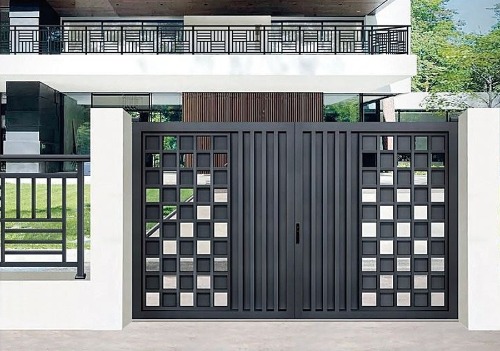
Different sites place different demands on an entrance gate. A residential driveway may have a relatively simple opening path, while a commercial entrance can involve more frequent movement and a wider access area. Some locations may also have limited clearance or uneven ground.
The surrounding layout should therefore be considered before the gate structure is selected. Important factors include:
A single-leaf gate can work where the opening is relatively narrow, while a double-leaf arrangement can divide the movement between two sides. The choice is not simply a matter of appearance. Each arrangement changes the weight carried by the hinges and the space required during opening.
The relationship between the gate and its surroundings also matters. A gate that opens inward needs sufficient clearance behind it. If the area contains a wall, parked vehicle, planting bed, or walkway, the opening path may need to be reconsidered.
For this reason, site conditions should be assessed together rather than treating the gate as an isolated component. The frame, hinges, posts, ground, and opening area all interact during normal use.
Gate size has a direct effect on how the structure moves. As the gate becomes wider or taller, the load carried by its supporting points can change. A large gate may also require more room to move through its opening path.
The proportions of the frame are therefore important. A narrow but tall gate behaves differently from a wider gate with a similar overall height. The location of the hinges also becomes more significant as the dimensions change.
When considering gate size, it is useful to look at several factors together:
| Consideration | Why It Matters |
|---|---|
| Gate width | Affects the opening path and load on the supporting points |
| Gate height | Changes the overall frame proportions |
| Gate weight | Influences hinge and support requirements |
| Opening direction | Determines the clearance needed around the gate |
| Infill arrangement | Can change the way the gate responds to outdoor conditions |
A gate should not be sized only according to the width of the entrance. The available space on both sides of the opening should also be considered. A gate may physically fit into an opening but still be inconvenient if there is not enough room for it to move.
The relationship between size and support becomes particularly noticeable when a gate begins to sag. A small change in alignment can cause the lower edge to move closer to the ground, making opening more difficult. Correct proportions and suitable support help reduce this type of issue.
Hinges connect the moving gate leaf with the fixed post, so their position has an important effect on movement. If the hinges are not aligned correctly, the gate can become difficult to open or may gradually move away from its intended position.
The upper and lower hinges need to work together. Their positions should provide stable support while allowing the gate to rotate without unnecessary resistance. Poor alignment can create uneven gaps around the frame or cause one side of the gate to sit lower than expected.
Another consideration is the relationship between the hinge position and the gate's center of weight. If the moving section places excessive load away from its support points, the hinges and posts may experience additional stress during use.
During installation, attention should be given to:
Hinge condition also affects daily operation. Dirt, corrosion, loose fasteners, or physical wear can increase resistance. When a gate becomes harder to move, checking the hinges and surrounding connections can be more useful than immediately changing the entire gate structure.
A sloped driveway introduces a different challenge because the ground level changes along the gate's movement path. A gate that works normally on flat ground may contact the surface when opened if the slope has not been considered during planning.
The direction of the slope matters. A gate moving across a changing surface may require a different opening arrangement from one moving along a relatively level path. The lower edge of the gate should have enough clearance throughout its movement.
Before installation, the opening path can be considered from several positions rather than checking only the closed position. The gate should have adequate space when partly open and fully open.
For sloped driveways, attention is commonly given to:
The goal is not simply to raise the gate higher. Excessive clearance can leave an unwanted gap beneath the gate, while insufficient clearance can cause contact with the driveway. The frame and installation position need to respond to the actual shape of the entrance.
Wind can change the way a swing gate behaves, particularly when the entrance is located in an exposed area. A closed gate can act as a surface against moving air, while an open gate may experience force from a different direction.
The design of the gate infill is relevant here. A more open arrangement allows some air to pass through, while a more enclosed surface can present greater resistance. This does not mean one arrangement is suitable for every location; the surrounding environment and gate size should be considered together.
Wind can also affect manual handling. A gate that feels easy to move under calm conditions may require more attention when the weather changes. Automatic operation can introduce another consideration because the opening equipment must work against the resistance created by the gate and its surroundings.
In open areas, it is useful to consider the usual wind direction, surrounding buildings, nearby fences, and the amount of exposed surface. These conditions can influence both the gate layout and its support structure.
A swing gate can be operated manually or connected to an automatic opening system. The suitability of automatic operation depends on the physical characteristics of the gate and the conditions in which it operates.
Gate size and weight are important, but they are not the only considerations. Hinge resistance, opening direction, ground clearance, and the movement path can also affect operation. If the gate is difficult to move by hand, adding an opener does not remove the underlying mechanical problem.
The opening system should therefore be considered after the gate movement has been properly established. A correctly aligned gate should move smoothly through its intended path before automatic operation is introduced.
For a double-leaf arrangement, the two sides also need to move in a controlled sequence. If one side closes earlier or moves differently from the other, the meeting point can become uneven.
Common signs of an operating problem include:
These symptoms can have different causes, so checking the gate itself, its hinges, and the opening path is an important part of troubleshooting.
Outdoor gates are exposed to moisture, dirt, and changing weather. Coastal locations add another environmental consideration because airborne salt can settle on exposed surfaces and connections.
The gate frame is only one part of the system. Hinges, fasteners, brackets, and other exposed components also need attention. Small areas where different materials meet can collect moisture and dirt, making routine inspection useful.
Surface maintenance is relatively straightforward. Removing accumulated dirt and residue helps keep the finish in reasonable condition. Areas around joints and moving components should also be checked because these locations can be harder to clean.
A gate installed near the coast can benefit from a maintenance routine that considers the local environment rather than following the same approach used in a sheltered inland location.
| Environmental Condition | Areas Worth Checking |
|---|---|
| Moisture | Hinges, joints, fasteners, and lower frame |
| Salt exposure | Exposed surfaces and connections |
| Dirt buildup | Corners, joints, and moving areas |
| Frequent rain | Drainage around posts and ground clearance |
| Strong weather | Gate movement, hinges, and support points |
Regular inspection can also reveal surface damage at an early stage. Scratches or worn areas should not simply be ignored, particularly when the gate is exposed to moisture on a regular basis.
Maintenance begins with observing how the gate moves. Changes in sound, resistance, alignment, or closing position can indicate that a component needs attention.
The gate surface can be cleaned periodically to remove dust and outdoor residue. Hinges should be checked for looseness or unusual movement, while visible fasteners and connections can be inspected for changes.
A simple maintenance routine can include:
The condition of the ground should not be overlooked. Soil movement, changes around paving, or minor shifts near the posts can affect the gate even when the frame itself has not changed.
If a gate begins to sag, rub, shake, or stop at an unusual position, correcting the underlying cause is preferable to repeatedly adjusting the moving section. A small alignment issue can become more noticeable when the gate is used regularly.
Different applications naturally place different demands on a swing gate. Size, installation conditions, ground slope, wind exposure, operating method, and local weather all influence how the gate functions. Considering these factors together allows the structure and installation approach to correspond more closely with the actual entrance environment.






Phone
(+86) 138 5893 5900
Address
Chengxi High-tech Zone, Yongkang City, Zhejiang Province, China
Media

 English
 Español
 русский