Call us for a FREE QUOTE: (+86) 138 5893 5900

Mail us to: [email protected]
Call us for a FREE QUOTE: (+86) 138 5893 5900
Mail us to: [email protected]


An entrance does more than mark the boundary between two areas. It needs to provide a practical passage for people, vehicles, or both, while working with the surrounding fence, posts, ground conditions, and available space. For this reason, choosing a gate is not simply a matter of selecting a preferred appearance.
An Aluminum Security Gate can be used in many different entrance layouts, but the suitable configuration depends on how the opening is used and what conditions exist around it. A pedestrian entrance may have very different requirements from a driveway, while a frequently used commercial entrance may need a different arrangement from a private property entrance.
Dimensions, opening space, hardware, installation conditions, outdoor exposure, and routine maintenance all have a connection with how a gate performs during everyday use. Looking at these factors together can make the selection process more practical and help avoid problems caused by choosing a gate without considering its installation environment.
The purpose of an entrance provides a useful starting point for choosing a gate. A pedestrian entrance usually needs convenient passage within a relatively limited area. A vehicle entrance, on the other hand, needs enough clear space for vehicles to enter and leave without creating unnecessary restrictions around the gate.
Some entrances are used by both pedestrians and vehicles. In these situations, the gate needs to work with the movement pattern around the property rather than being considered as an isolated structure.
Usage frequency also matters. An entrance that is opened occasionally may have different practical requirements from one that is operated repeatedly throughout the day. The surrounding layout should also be considered. A gate located beside a walkway, parking area, driveway, or fence corner may need a different arrangement to prevent interference during opening and closing.
| Entrance situation | Points to consider |
|---|---|
| Pedestrian access | Passage width, convenient operation, surrounding walkway |
| Vehicle access | Clear opening, vehicle movement, opening space |
| Shared access | Separation of movement, opening direction, daily use |
| Restricted area | Access arrangement, surrounding barriers, gate position |
This means the intended use should be defined before selecting the gate itself. A clear understanding of how people and vehicles approach the entrance gives the following selection steps a practical foundation.
Once the entrance purpose is clear, dimensions become an important consideration. Measuring only the opening between two posts may not provide enough information. The surrounding area can influence whether the finished installation works comfortably.
The clear opening should be considered together with the width and height of the gate. For vehicle access, the available passage needs to accommodate the expected movement without forcing vehicles too close to posts, walls, or other obstacles. For pedestrian entrances, the available walkway and the direction of movement should also be taken into account.
The position of existing posts is another relevant factor. If a new gate is being installed within an existing fence, the distance between posts may limit the available gate arrangement. A replacement project may therefore require different measurements from a new installation.
Useful measurements can include:
These measurements help connect the gate size with the actual entrance rather than treating dimensions as an independent specification.
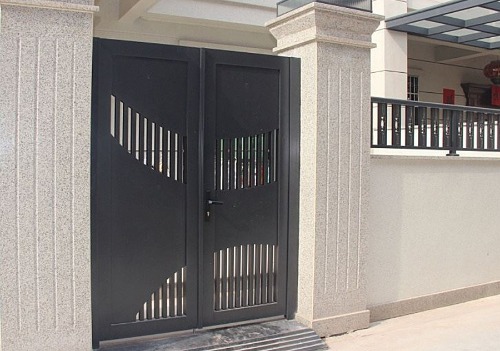
The available space around an entrance can influence how the gate should open. A swing arrangement needs room for the gate leaf to move through its opening path. If that area is occupied by a driveway, walkway, wall, landscaping, or parked vehicles, the movement of the gate may interfere with normal use.
A sliding arrangement can work differently because the gate moves along the side of the opening rather than through the entrance area. However, the side space must be available for the gate to move into. An entrance with limited side clearance may therefore require another arrangement.
Opening direction also deserves attention. A gate that opens toward a frequently used walkway can affect pedestrian movement. A gate that opens into a vehicle area may need to account for where vehicles stop and how they approach the entrance.
| Opening arrangement | Space to examine | Suitable consideration |
|---|---|---|
| Swinging | Area in front of or behind the opening | Whether the gate has enough movement space |
| Sliding | Space alongside the opening | Whether the side area remains clear |
| Single leaf | Space used by one moving section | Whether the opening width can be handled conveniently |
| Double leaf | Space used by two moving sections | Whether the center opening and surrounding area allow both sections to move |
The opening method should therefore follow the physical conditions of the entrance. Choosing an arrangement without checking the available movement area can create avoidable interference during daily operation.
After the gate size and opening arrangement have been considered, attention can move to the hardware that supports daily movement. Hinges, locks, latches, handles, and other connecting parts all have a role in how the gate opens, closes, and remains in position.
Gate weight is relevant because the supporting hardware needs to work with the physical load of the gate. A larger or heavier gate can place different demands on hinges and supporting points than a smaller gate. Opening frequency can also influence how these components are used over time.
Hardware placement matters as well. Hinges need to be positioned so that the gate can move properly, while the locking components need to align with the frame or receiving point. Small differences in alignment can make operation less convenient.
When reviewing hardware, it is useful to consider:
The hardware should be treated as part of the overall gate arrangement rather than as an afterthought. A suitable combination of gate structure and supporting components can make everyday operation easier to manage.
A suitable gate can still encounter operating problems if the installation area is not properly considered. Ground conditions are particularly important because the lower edge of a moving gate needs enough clearance to operate without unnecessary contact with the surface.
Uneven ground can change the relationship between the gate and the entrance as the gate moves. Sloping driveways, raised paving, drainage channels, and changes in ground level can all affect the available clearance.
The supporting posts also need attention. Their position determines where the gate sits within the entrance and can influence the alignment between the gate, hinges, and locking point.
Before installation, the surrounding area should be checked for:
These conditions are especially relevant when replacing an existing gate. The new gate may have different dimensions or movement requirements, so the existing opening should not automatically be assumed to be suitable without checking.
Outdoor exposure creates another set of considerations. Rain, moisture, dust, and coastal air can affect how a gate and its hardware are used and maintained. The impact may vary according to the local environment and how exposed the entrance is.
Water can collect around ground-level areas if drainage is limited. Dust and debris can also gather around hinges, latches, tracks, and other moving or connecting parts. These conditions do not necessarily prevent normal operation, but they make regular inspection more relevant.
For an Aluminum Security Gate installed in an exposed location, the surrounding environment should be considered alongside the gate itself. A covered entrance may have different maintenance needs from a gate positioned in an open driveway.
Coastal locations deserve particular attention because salt-containing moisture can affect exposed hardware and nearby components. Regular cleaning and inspection can help identify changes before they interfere with normal operation.
The practical approach is to match the maintenance routine with the environment rather than applying the same schedule to every installation.
Routine maintenance is closely connected with the way a gate is used. A gate that becomes harder to open, does not close correctly, or begins to make unusual sounds may need inspection of several related components.
Hinges are worth checking because they support repeated movement. Locks and latches should also be inspected to make sure they align properly when the gate reaches the closed position. For sliding arrangements, the movement area should remain free from objects and accumulated debris.
A basic inspection can focus on the following conditions:
Cleaning should also reflect the installation environment. Outdoor gates can collect dust and other debris around moving areas, while exposed hardware may require closer attention in damp or coastal surroundings.
Maintenance is therefore not limited to cleaning the visible surface. Checking how the gate moves and closes can provide useful information about whether adjustment or attention is needed.
Choosing a gate becomes more straightforward when the entrance is considered as a complete operating area. The purpose of the entrance establishes the basic requirements, while dimensions determine how much space is available. The surrounding layout then influences the opening arrangement, and the gate structure needs to work with its supporting hardware.
Installation conditions add another layer. Ground level, post position, drainage, and nearby structures can affect how the gate is positioned and how it moves. Outdoor exposure then influences the attention required during regular use.
A practical selection sequence can therefore look like this:
Entrance purpose → available dimensions → opening space → gate arrangement → hardware → installation conditions → outdoor environment → maintenance
This approach keeps the focus on the relationship between the gate and its surroundings. It also allows different entrances to be evaluated according to their actual use instead of applying one arrangement to every location.
For buyers, installers, and property managers, the key consideration is whether the chosen gate fits the entrance as a working system. When dimensions, movement space, supporting components, ground conditions, and maintenance needs are considered together, the resulting choice is easier to align with everyday access requirements.


Phone
(+86) 138 5893 5900
Address
Chengxi High-tech Zone, Yongkang City, Zhejiang Province, China
Media

 English
 Español
 русский